The institutional memory
for your infrastructure.
Monitoring · ITSM · AI diagnostics · compliance — one platform
Cortex captures every incident, every resolution, every pattern — and pays it forward. Your team never fights the same fire twice.
- Knowledge outlives tenure. Your senior engineer's fixes stay after they resign.
- High-confidence remediations run themselves. You set the gate; every action is reversible.
- Every CIO figure cites a source record — not an inference.
This site runs on Cortex — monitored, healed, and audited by our own production instance.
- First topology in 60 seconds
- On-prem, hybrid, or SaaS
- BYOK AI (Anthropic / OpenAI / Gemini)
- GLBA / SOC 2 / HIPAA / PCI-DSS ready
The knowledge graph — every incident, fix, change, and dependency your operation has ever recorded, as one living structure. Recorded live from our demo tenant.
The ticket arrives already investigated.
This is the moment Cortex sells itself. An alert becomes an incident — and the incident shows up with the investigation already done. Rendered below exactly as on-call sees it in the live demo tenant.
inc-p1-online-banking-evening-000 (Jan 31) — evening traffic surge → connection-pool saturation → 503s. Resolved in ~60 min by scaling the worker pool. Citation quality: strong (91/100)
CHG-00123 deployed to an upstream dependency 47 minutes before the first alert (risk: moderate, author on-call notified). LIKELY CAUSE
3 downstream services, member-facing login and payments. $15K/hr revenue exposure; SLA breach projected in 2.6h if unresolved. Every figure cites its source record.
No escalation for context. No war room asking what changed. On-call starts at the fix, not the investigation. Book a walk-through and watch a real one arrive →
You're buying four tools and still paying this tax
Monitoring, ITSM, AIOps, and a CMDB — four stacks, four renewals, and the same three problems.
Alert fatigue is burning on-call
One upstream failure fires 1,000 alerts. Your on-call wastes an hour finding the root cause topology would answer in seconds. Your SRE team is leaving for a company that doesn't page them seven times a night.
Knowledge walks out the door
Your principal engineer gives notice and takes ten years of "the weird firmware thing on blade 7 during B-side failover" with them. Nobody wrote it down. Runbooks wouldn't have captured it anyway. The next P1 costs two hours and three war-room invites you didn't need to send.
Same incident, different quarter
It happened last March. Nobody remembers the fix. The runbook is six versions stale. The war room starts from scratch, on a Saturday, with the same three people asking "did anyone change anything?" The answer is yes — and your monitor doesn't know.
How Cortex works
Six steps from noise to institutional memory
Collect
33 collectors pull from your existing stack. Prometheus, Datadog, CloudWatch, vSphere, NetApp, SNMP — no rip and replace.
Detect
Real-time anomaly detection with online baselines — learns from day one. No training window, no cloud lock-in, no LLM token spend to score a metric.
Correlate
Topology-aware grouping reduces 1,000 alerts to 1 incident. Dependency analysis finds the upstream cause, not the downstream symptoms.
Remember
Every resolution is captured and linked to symptoms, root cause, affected systems, and the fix. Searchable forever. Context is never lost.
Heal
Playbook-based remediation fires automatically when confidence is high enough. Below the threshold, it suggests the fix and waits for approval.
Learn
Every success and failure adjusts pattern confidence. The system gets better. Operator feedback is first-class — approve, reject, annotate, suppress.
What makes Cortex different
Not another dashboard for dashboards. A system that remembers, reasons, and cites its work.
Institutional Memory
Every resolution becomes a structured, searchable artifact — symptoms, root cause, affected systems, the fix, who wrote it, when. New incidents surface the historical fix by matching what actually happened — not keyword search, not an LLM guessing. Your team's experience outlives any one engineer's tenure.
Living Topology
A dependency map built from how your infrastructure actually fails — not from a hand-curated CMDB that went stale six months ago. It traverses "disk full on storage-array-7" to "$15K/hr revenue exposure" in milliseconds, and it cites every edge it crossed to get there.
Self-Healing
YAML playbook remediation with confidence scoring on every pattern. Above your threshold, it fires automatically and records the outcome. Below, it suggests the fix and waits for approval — with the full evidence chain displayed. Failures adjust confidence down, successes up. You set the gate. You can roll back any action.
Honest AI — Every Figure Cites Its Source
Every precedent citation is scored 0–100 at resolve time. Every prevented-outage claim has a per-record appendix with the threshold rule that selected it. Every AI diagnosis names the tools it called, the records it consulted — and the matches it rejected, with reasons. A second fresh-context pass tries to refute the diagnosis before any auto-remediation is allowed. No black-box AIOps score, no "trust us, it's magic." See verbatim diagnostic output from a real P1 →
Progressive Trust
Start read-only. Cortex watches, learns, and recommends. Add approval gates when your team's comfortable. Move to full automation per-system, not all-or-nothing. Every action writes a tamper-evident audit entry tying it to a user, a reason, and a reversible diff. Roll back in one click. Never stuck with automation you don't trust yet.
Service Desk That Thinks
Full ITSM — incidents, problems, changes, catalog, CMDB — with a CSDM-aligned data model that imports from ServiceNow in one command. New tickets arrive pre-enriched: topology context, correlated changes, known errors, suggested runbooks with citation-quality scoring. On-call doesn't escalate for context because the context is already on the ticket. Customer extensions are data, not code — they survive every upgrade.
The Agent Looks Before It Thinks
Before the diagnostic agent touches an alert, it reads a deterministic briefing: releases executing in the blast radius, changes touching the stack in the last two hours, neighbor incidents, active maintenance windows. It doesn't have to remember to check — the briefing always runs first, and every finding cites its source record. See a real briefing →
One platform. Six products. Replaces your stack.
Every module feeds the same knowledge graph. Each makes the others smarter. Missing modules degrade gracefully — deploy only what you need. One renewal, one login, one source of truth.
Cortex
Infrastructure Intelligence · replaces Datadog / New Relic AIOps
Self-healing monitoring with living topology, alert correlation, and institutional memory. The foundation everything else plugs into.
- 1,000 alerts → 1 root-cause incident
- Blast radius in milliseconds
- Patterns compound in confidence as they fire
Service Desk
Enterprise ITSM · replaces ServiceNow / BMC Remedy
Full ITSM with a CSDM-aligned CMDB — tickets arrive pre-enriched with topology, precedents, and blast radius. One-command migration from ServiceNow.
- Incidents, Problems, Changes, Catalog, CMDB
- Pre-enriched tickets save on-call escalations
- Customer fields survive every upgrade
Atlas AI
Agentic Diagnostics · replaces BigPanda / Moogsoft AIOps
An autonomous diagnostic agent that searches your operational history before the LLM reasons, and returns a cited, confidence-scored root cause. Bring your own API key.
- Structured RCA with cited evidence
- Searches history before the LLM guesses
- Bring your own API key — no lock-in
FinOps
Cloud Cost Management · replaces Apptio Cloudability / CloudHealth
Unified Azure / AWS / GCP cost visibility that feeds change simulation — the price tag and the blast radius on the same pre-deploy report.
- Cost by resource, service, and team
- Waste finder with reclaim estimates
- Pre-deploy cost + risk on one screen
Compliance
Automated Evidence · replaces Drata / Vanta
SOC 2, GLBA, HIPAA, PCI-DSS, ISO 27001 evidence generated from live operational records — regenerable on demand, never a stale screenshot.
- 5 frameworks, evidence from source records
- Drift detection auto-opens remediation tickets
- Regenerable on demand — no cached inference
Deploy
Infrastructure Orchestration · complements Terraform Cloud / Spacelift
Terraform orchestration with landing zones, promotion gates, and drift detection — every plan simulated for blast radius and cost before production.
- Blast radius + cost + risk on every plan
- Per-env promotion gates (tests / cost / drift / manual)
- Drift detection auto-opens remediation changes
See the receipts.
These figures come from Cascadia — our demo tenant modeling a regional credit union with 140+ incidents, 30 work sessions, and 90 days of operational history. Every number traces to a source record. We spin the tenant up live on every walk-through — you can poke around and regenerate the PDF yourself.
Live as of — · — incidents in window
The honest part. The prevented-outage count comes with a per-record appendix naming
every session that contributed — the threshold rule that selected it, the risk score, and a one-sentence AI-written
business-risk narrative. The citation rate's 18% isn't a self-reported average: each tag was written at ticket-resolve time
by a named resolver via the /resolve
API and carries an audit event. Avg quality is the weighted mean across strong / moderate / weak matches, scored at
citation time. No cached inference, no vanity metrics.
The demo tenant runs on demand — we bring it up for every walk-through so you always see it warm and current.
Break something. Watch Cortex fix it.
Cascadia is a real, writable Cortex tenant. On every walk-through we trigger a live failure and you watch it propagate through the topology, fire the matched runbook, and post the resolution to institutional memory — three minutes end-to-end. No slides.
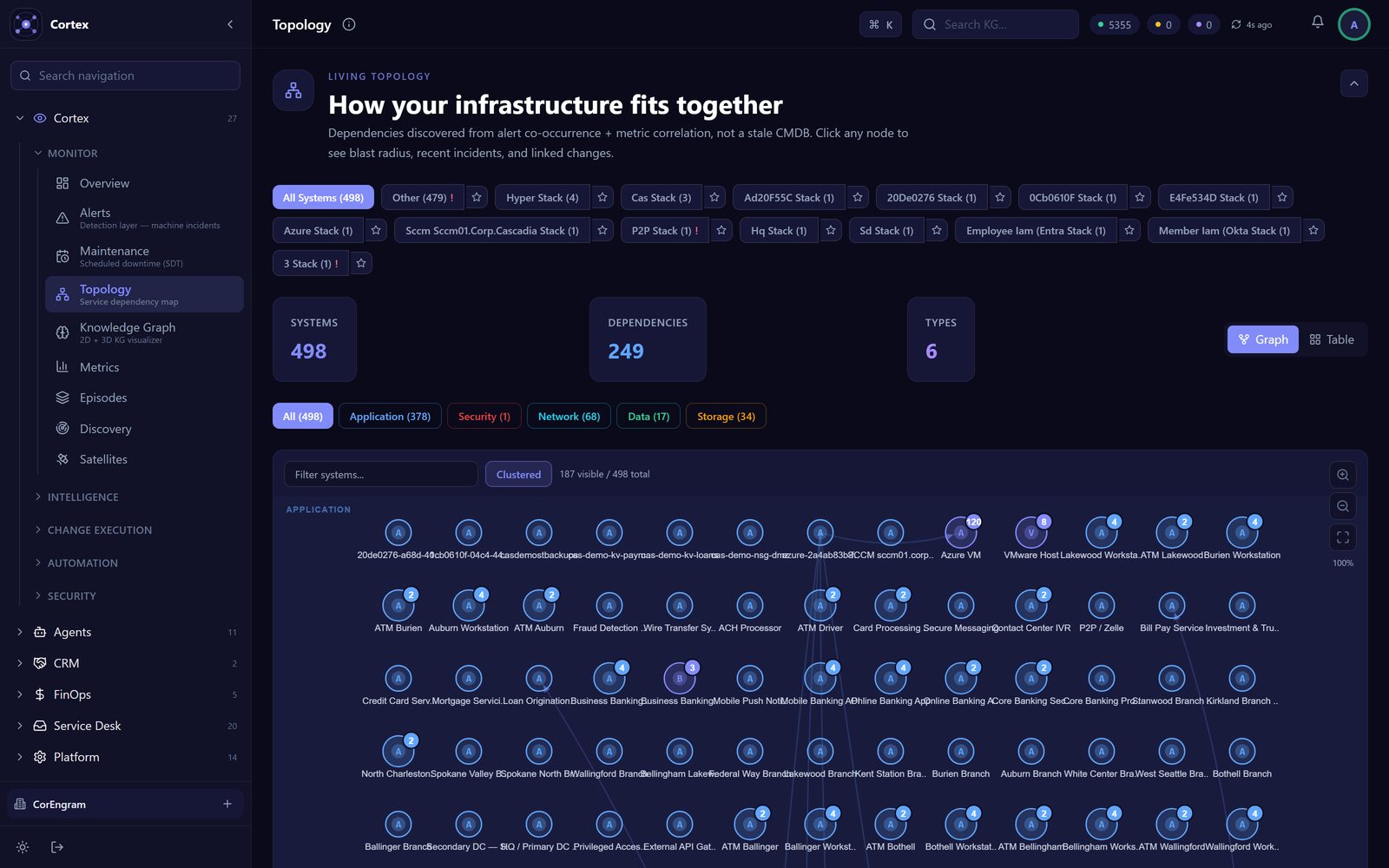
Two environments: Cascadia (credit-union workload, 140+ incidents seeded — wakes on demand, sleeps between visitors) and cortex.corengram.ai (monitoring CorEngram AI's own infrastructure — every incident is real).
How it learns
Cortex gets smarter the longer it runs. Here's the ramp.
Discovers your infrastructure
Port scanning, Docker API, Kubernetes API, cloud provider metadata. Automatic collector assignment. First topology edges appear.
Maps topology, identifies single points of failure
Dependency map built from alert co-occurrence and metric correlation. Single points of failure flagged. Blast radius estimates on every system.
Baselines established, anomalies detected
Welford's online algorithm learns normal. No training window — baselines start from the first data point and refine continuously.
Institutional memory growing, patterns forming
Resolutions linked to symptoms and root causes. Causal patterns learned from incident sequences. Runbooks auto-generated from history.
Self-healing with confidence, executive insights dense with data
High-confidence patterns execute automatically. Capacity forecasts predict issues weeks out. CIO dashboards show trends, not just status.
Built for regulated industries
Examiner-ready evidence generated from live operational records. Every control maps to a KG entry with a timestamp, an actor, and a diff — not a vendor questionnaire from 2023.
Credit Unions & Banks
7/7 Safeguards Rule controls mapped to KG entries. 7-year audit retention. Access controls, encryption-at-rest, incident response, vendor oversight — all cite source records. NCUA § 748.2 change-control evidence exports in a single report.
Type II Ready
Trust Service Criteria covered across Security, Availability, Processing Integrity, Confidentiality, and Privacy. Continuous evidence — not a once-a-year scramble. Change control, access reviews, incident response tied to actual tickets.
DSS 4.0
Payment data isolation tracked in the CMDB. Role-based access enforced and audited. Change tracking with blast-radius impact on CDE boundaries. Quarterly ASV scan evidence integrates via the Compliance collector.
ePHI Handling
Administrative, physical, and technical safeguards. PHI access audit trail with tamper-evident logging. Risk assessment artifacts regenerable on demand. BAA-compatible deployment architecture — on-prem or private Azure.
Cortex is compliance-ready infrastructure — you still bring the audit relationship and the formal attestation. What Cortex eliminates is the evidence-gathering scramble and the gap between what your controls say and what your operations actually did. Ask to see a live regulator-ready export from the Cascadia demo.
We run Cortex on Cortex.
Our production instance at cortex.corengram.ai monitors CorEngram AI's own infrastructure — every container, every Postgres pool, every Azure resource behind this website. Every incident, every learned pattern, every compliance record shown there is real. We eat our own dog food daily, which is how we find the bugs before you do.
Plugs into your existing stack
33 collectors across every major infrastructure category. Cortex reads your tools, doesn't replace them — until you're ready. Then it does, one module at a time.
Plus an AI-powered connector generator: paste an API doc URL, get a validated collector in under 10 minutes.
Built-in safety sandbox blocks subprocess, eval, pickle, and unsafe network patterns before any new collector touches production.
Pricing that doesn't punish adoption
Priced by managed CIs — the infrastructure Cortex watches for you. Every integration is free. Every module is additive. No per-seat tax, so your whole team can be in the tool; no per-GB ingest surprise at renewal. Start with monitoring, add modules when they earn it.
See it on your infrastructure
30 minutes. A shared screen. We run Cortex against a slice of your actual environment — your monitoring feeds, your recent incidents, your topology. You see the first auto-discovered dependency map, the first institutional-memory match on a real historical incident, and the first compliance-evidence export. No slides. If it isn't useful in 30 minutes, we're wasting each other's time.
hello@corengram.ai